Event maps: from canonical to destination names
How ramztracker translates the four canonical events into the names each destination expects — Meta's Purchase, an affiliate's conv, or your own webhook event — and the sensible defaults you start from.
Your app sends canonical events. Every destination wants its own names. Event maps are the per-space translation layer that sits between them — so you never hardcode a destination name in your app.
The idea
For each destination you configure, you map every canonical event to the name that destination expects:
canonical          fb_capi destination
─────────          ───────────────────
contact         →  Contact
subscribed      →  Lead
registration    →  CompleteRegistration
deposit         →  Purchase
When a deposit arrives, ramztracker looks up the map for each destination and dispatches Purchase to Meta, conv to your affiliate network, and deposit to your webhook — all from one event.
Sensible defaults
A fresh destination isn't blank. ramztracker pre-fills these defaults so you can ship immediately:
| Canonical | Facebook CAPI | Webhook / S2S postback |
|---|---|---|
contact |
Contact |
contact (identity) |
subscribed |
Lead |
subscribed |
registration |
CompleteRegistration |
registration |
deposit |
Purchase |
deposit |
Facebook gets its standard funnel event names. Webhooks and S2S postbacks default to the canonical code itself (identity mapping) — most people keep that and filter on the receiving side.
Editing a map
Open a destination's event maps in the dashboard. Each row is canonical → target name:
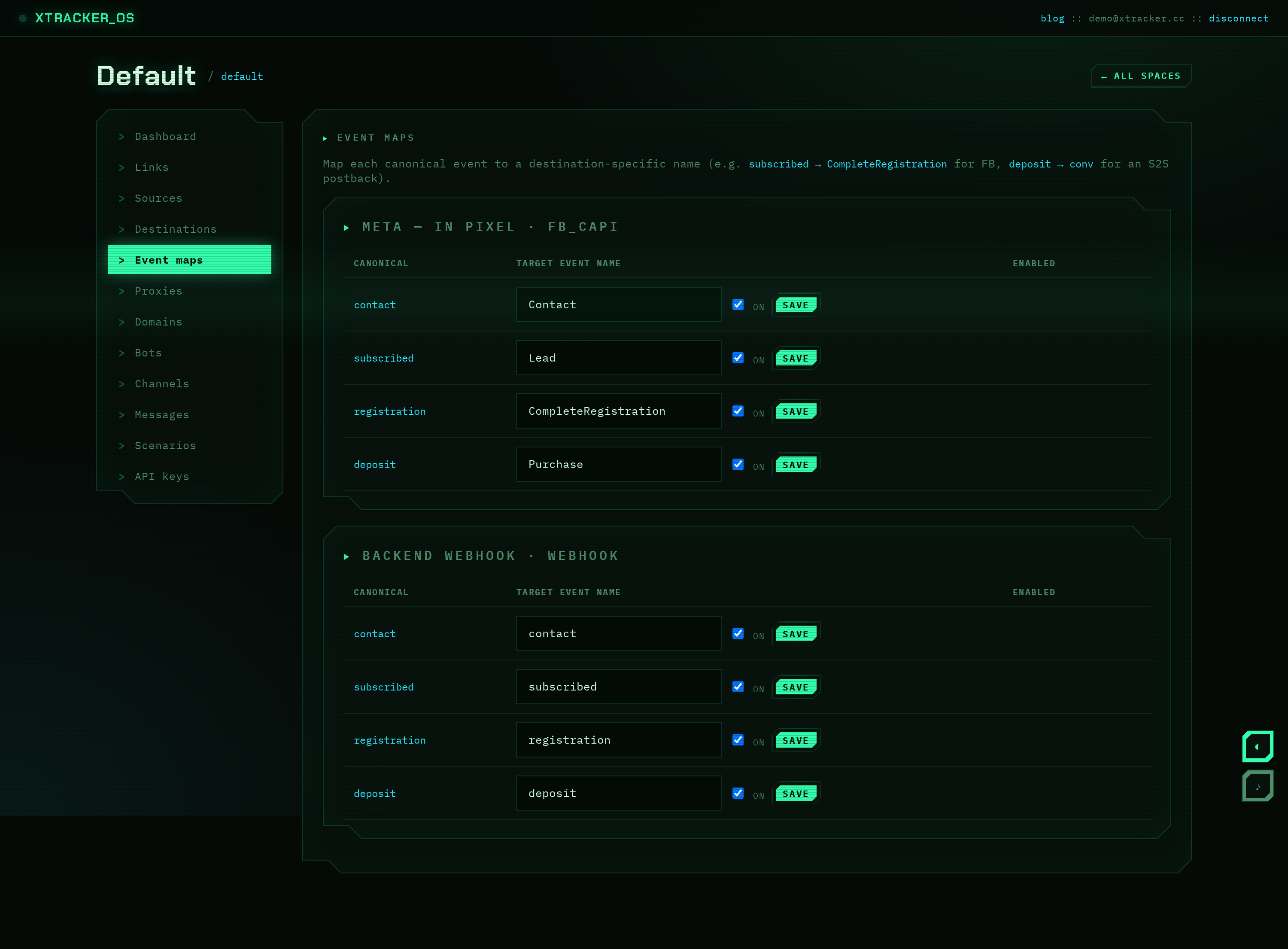
Change the right-hand side to whatever your destination expects. For an affiliate network that wants lead and conv:
subscribed    →  lead
registration  →  lead
deposit       →  conv
Note you can collapse several canonicals onto one target (here both subscribed and registration become lead) — handy when a network only recognises two event types.
Unmapped events
If a canonical has no target name for a destination, that event simply isn't dispatched there. So if you only want deposits sent to a network, leave the other three blank for that destination.
Next
- Destinations — the three destination kinds and how delivery works.
- Webhook payload reference — exactly what your webhook receives.
Keep reading
How to find and fix the leak in your funnel
A practical walkthrough: use the funnel breakdown and conversion gauge to pinpoint exactly where users drop off, form a hypothesis, fix one thing, and measure the lift.
PlaybookKeep your finger on the pulse: real-time conversion monitoring
A live dashboard isn't a vanity metric — it's an early-warning system. Here's how watching conversions in real time catches broken funnels and dead campaigns before they burn your budget.
PlaybookSame budget, more deposits: optimizing creatives with per-link data
Clicks lie. Deposits don't. Use per-link attribution to see which creative actually drives revenue — then move spend to the winner and kill the losers.