How to find and fix the leak in your funnel
A practical walkthrough: use the funnel breakdown and conversion gauge to pinpoint exactly where users drop off, form a hypothesis, fix one thing, and measure the lift.
Every funnel leaks somewhere. The winners aren't the ones with no leaks — they're the ones who find the biggest leak, fix it, and repeat. Here's the loop.
Step 1: look at the shape
Open the funnel breakdown for the last 7 days. You're not reading numbers yet — you're reading the shape:
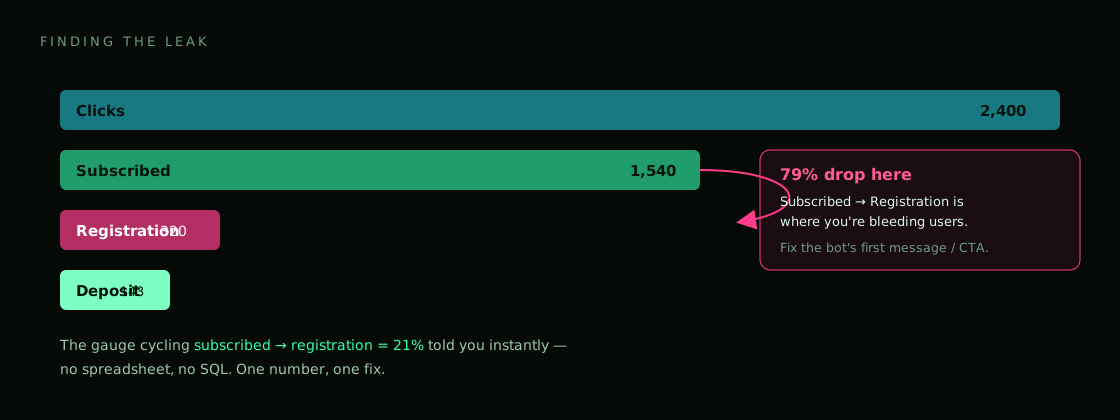
A healthy funnel tapers smoothly. A leak looks like a cliff. In the example above, Subscribed → Registration falls off a cliff: 1,540 → 320. That's a 79% drop at a single step. That's your target.
Step 2: confirm with the gauge
The conversion gauge cycles each step's ratio. Watch for the one that's far below the others:
click → contact          64%
click → subscribed        41%
contact → registration    21%   ← the outlier
registration → deposit    18%
The gauge just confirmed the funnel shape: the contact→registration / subscribed→registration step is where you're bleeding. Now you know where, not just that.
Step 3: form one hypothesis
Don't change five things. Pick the single most likely cause for this specific step:
- Subscribed → Registration leaking? Your bot's first message is probably weak — no clear CTA, no urgency, or the offer link is buried. Or the offer's signup is too heavy.
- Click → Subscribed leaking? The landing or invite flow has friction — slow load, confusing CTA, broken deeplink.
- Registration → Deposit leaking? The offer's deposit step scares people — unclear value, no incentive, wrong geo.
Step 4: change one thing, measure
Fix exactly one thing — say, rewrite the bot's welcome with a single bold CTA and a deposit incentive. Then watch that one gauge number over the next few days.
Because you changed one variable, any movement is attributable. If contact→registration goes 21% → 34%, you didn't get lucky — you found the lever. If it doesn't move, revert and try the next hypothesis. This is how you compound.
Step 5: filter to isolate
Use the date and campaign filters to make the signal clean:
- Filter to a single campaign so a leak in one creative isn't hidden by another.
- Compare this week to last (the vs-previous delta does this for revenue automatically).
- Check the by-link table — sometimes the "leak" is really one bad link dragging the average down (more on that in optimizing creatives).
Why this beats guessing
Most people "optimize" by changing things that feel important and hoping. The funnel view replaces hope with a target: the biggest drop-off is the highest-leverage fix, full stop. You stop polishing the parts that already work and attack the part that's actually costing you deposits.
The loop
- Find the biggest drop in the funnel.
- Confirm with the gauge.
- One hypothesis, one change.
- Measure that step.
- Repeat on the next-biggest leak.
Run this loop weekly and your funnel gets monotonically better.
Next
- Keep your finger on the pulse — monitor in real time.
- Optimize creatives with per-link data — find which links convert.
- Reading your dashboard — the widgets in detail.
Keep reading
Keep your finger on the pulse: real-time conversion monitoring
A live dashboard isn't a vanity metric — it's an early-warning system. Here's how watching conversions in real time catches broken funnels and dead campaigns before they burn your budget.
PlaybookSame budget, more deposits: optimizing creatives with per-link data
Clicks lie. Deposits don't. Use per-link attribution to see which creative actually drives revenue — then move spend to the winner and kill the losers.
PlaybookThe deposit you almost counted twice
A story about exactly-once tracking: how retries and re-fired postbacks silently inflate (or lose) revenue, and how dedup + a durable outbox keep your numbers honest.